Create a Script
You can create scripts, specify the devices on which you want to run the scripts.
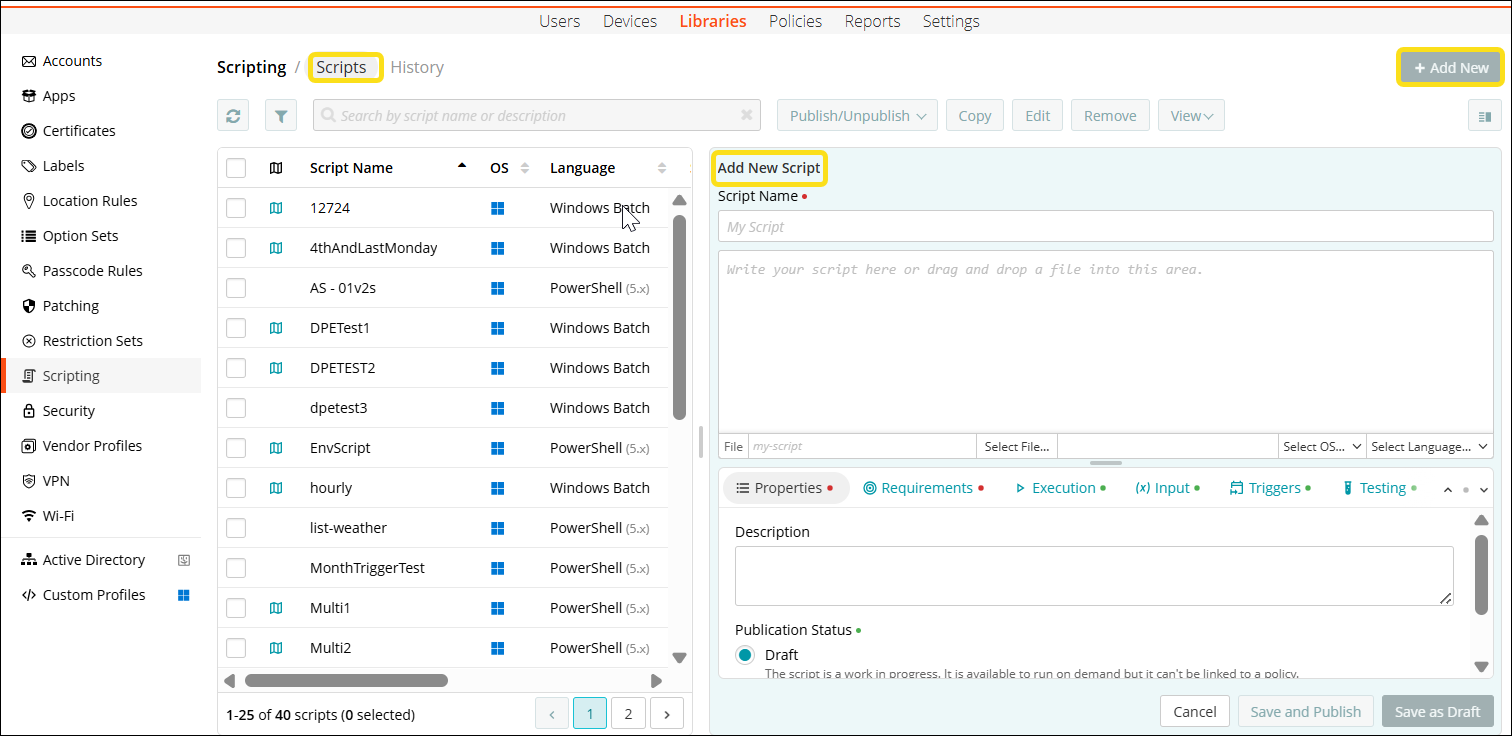
To create a script,
- Navigate to Libraries > Scripting.
- On the Scripting page, click Add New to open the Add New Script pane.
- Enter the script details:
- Script Name - Add a meaningful script title in the box.
- Script text box - Enter the script text in one of following ways.
- Type the script manually in the text box.
- Drag and drop an existing script file into the text box.
- Upload a script file - To upload a script file, follow the steps -
- Click Select File.
- Browse to the file location.
- Select the desired script file to upload.
- Script File - The script name entered in the Script Name field populates here.
- Select OS - Select Windows or macOS.
- Select Language - Select the script language. Add the script in the text box below.

NOTE: Once you create the script, the OS and the Language settings cannot be modified.
- In the Properties section,
- Description - Add details or information related to the script.
- Publication Status -
Draft - Select this option if the script is a work in progress. You can test it on demand on device(s).
Published - Select this option if the script is ready. You can test it on demand on device(s).
- In the Requirements section,
- Operating System- if selected earlier, the operating system is auto selected.
- Language - If selected earlier, the field is auto-populated. If you select PowerShell, ensure yo add a correct version in the next field.
- PowerShell Version : Select the PowerShell version from the drop-down list.
Ensure that the selected version of PowerShell is installed on each target device before attempting to run the script. - Dependencies: Attach necessary dependency files. For more information, see Adding Dependencies.
- In the Execution section, the settings can be overridden when running the script on demand or linking it to a policy.
- User Account - Select the option from the following.
System - Select this option if you want to run the script as the Local System or root account.
Current User - Select this option if you want to run the script as currently logged user account. - Timeout - Choose a duration from the drop-down. The script automatically stops running when the selected timeout period is reached.
- User Account - Select the option from the following.
- In the Input section, the settings can be overridden when running the script on demand or linking it to a policy.
- Environment Variables: Set custom variables, such as Name, Value, Hidden, if required. For more details, see Adding Hidden Environment Variables .
- In the Triggers section, choose when the script should run on devices if linked to a policy.
- After a device starts up - The script executes when the system starts
- After a user logs on - The script executes when the user logs on.
- On a schedule - The script runs on specified days, weeks, or times. When you select this option, you must specify the schedule by clicking Add Schedule.
For more information on Triggers, see Adding Triggers to a Script .
- In the Testing section, you run the script to test if it is working fine.
For more information on Testing, refer Testing a Script topic.
- Click Save and Publish to publish the script or Save as Draft to save the script as a draft.
If a script is saved as draft, you can publish it later.